


The Swatch x Rolex Collaboration That Could Reshape Luxury Watches Forever
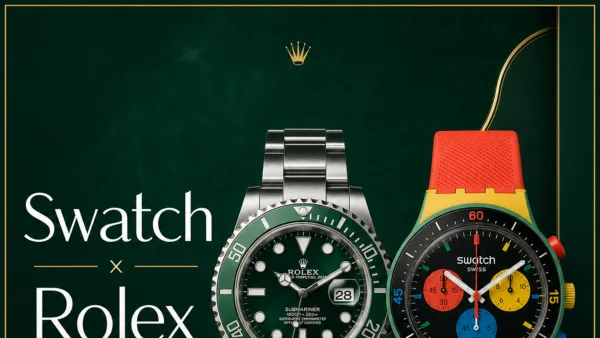
What Happens When the Most Accessible Watch Brand Meets the Most Exclusive One?
In March 2022, Swatch did something nobody expected. It took Omega’s Speedmaster Moonwatch, the same chronograph NASA certified for spaceflight, and rebuilt it in bioceramic plastic for $260. The MoonSwatch sold over a million units in its first year. Lines wrapped around blocks in Tokyo, London, and New York. Resale prices hit seven times retail. The collaboration between a $200 fashion watch brand and a $5,000+ luxury chronograph maker didn’t just work. It broke the industry’s understanding of what a “collaboration” could accomplish.
So here’s the question that keeps watch forums lit up at 2 AM: what if Swatch did the same thing with Rolex?
A Swatch Rolex collaboration sounds absurd on the surface. Rolex doesn’t collaborate. Rolex doesn’t need to collaborate. The Geneva giant pulled in an estimated CHF 10.5 billion in revenue for 2024, producing roughly 1.176 million watches and commanding 32% of the entire luxury watch market by value. But then again, nobody thought Omega would team up with Swatch either, and that partnership became the most talked-about watch release of the decade.
Let’s explore what a Swatch x Rolex collection could look like, what the economics would say, and why the idea isn’t nearly as crazy as it sounds.

The MoonSwatch Blueprint: How Swatch x Omega Rewrote the Rules
Before we imagine Rolex, we need to understand why the MoonSwatch worked so well.
Swatch and Omega share a parent company: the Swatch Group. That’s the corporate architecture that made the MoonSwatch possible — Omega’s design DNA flowing into Swatch’s bioceramic manufacturing pipeline, no licensing negotiations required. The result was a 42mm quartz chronograph that faithfully reproduced the Speedmaster’s dial layout, subdials, tachymeter bezel, and even the dot-over-90 detail that Speedmaster collectors obsess over.
The pricing was the real shock. A genuine Omega Speedmaster Professional retails around $7,000. The MoonSwatch cost $260. That’s not a discount. That’s an entirely different market segment gaining access to one of horology’s most revered silhouettes.
The numbers tell the story. Over one million MoonSwatches sold in year one. Launch-day queues that circled city blocks. Resale prices on Chrono24 and eBay peaked at roughly $1,800 for models like the Mission to Neptune, which was a seven-fold markup over retail. Even as supply improved through 2023 and 2024, the harder-to-find variants continued trading above retail.
Here’s what most buyers overlook, though: the MoonSwatch didn’t cannibalize Omega Speedmaster sales. If anything, it functioned as a gateway. People who bought a MoonSwatch at 25 often found themselves shopping for the real Speedmaster by 30. Swatch Group CEO Nick Hayek understood something the rest of the industry was slow to grasp: accessibility doesn’t dilute desire. It amplifies it.
What’s funny is that the fashion industry figured this out a decade earlier. Virgil Abloh’s Off-White collaboration with Nike in 2017 proved you could slap a $130 price tag on a shoe that looked and felt like a $2,000 designer sneaker, and both brands came out ahead. Adidas x Gucci, H&M x Balmain, Uniqlo x JW Anderson — the playbook became so established that “democratizing luxury” turned into a marketing cliché. Watchmaking was just remarkably slow to catch on. For an industry that literally measures precision, Swiss horology has a terrible sense of timing when it comes to cultural shifts. The MoonSwatch arrived about five years late to a party that sneakerheads had been throwing since 2015.
The AP Precedent: When Swatch Touched Audemars Piguet
Most people forget that the MoonSwatch wasn’t Swatch’s first foray into ultra-luxury territory. In 2024, Swatch released a $400 pocket watch that directly referenced the Audemars Piguet Royal Oak. Same octagonal bezel. Same “Grande Tapisserie” dial texture. Same exposed screws. Made in bioceramic, priced at a fraction of a Royal Oak’s $40,000+ sticker.
The reaction from AP collectors was predictably heated. Purists called it a cheapening of the Royal Oak’s legacy. But AP itself didn’t suffer. Royal Oak waitlists remained years-long. The secondary market for AP watches didn’t budge. The pocket watch sold out instantly, became a collector’s item in its own right, and proved that Swatch could borrow design language from even the most exclusive maison without causing real damage.
The pattern is clear now. Swatch has a formula: take an iconic silhouette, rebuild it in bioceramic, price it between $250 and $500, and manufacture hype through limited distribution. The MoonSwatch proved it works with chronographs. The AP pocket watch proved it works with integrated luxury sports watches. Rolex sits squarely in the crosshairs of both.

Five Concept Watches: Imagining a Swatch x Rolex Collection
If a Swatch Rolex collaboration ever materialized, what would the watches actually look like? Drawing from the MoonSwatch playbook and Rolex’s most iconic models, here are five concepts that would have collectors camping overnight.
1. SwatchMaster — Mission to the Deep

The Rolex Submariner is arguably the most recognizable watch on earth. The SwatchMaster would translate its 41mm case, Mercedes hands, and rotating dive bezel into bioceramic. Picture a matte black case with a rotating aluminum bezel insert in navy blue. The dial would use luminous painted indices instead of applied white gold ones, and the movement would be a reliable Swiss quartz.
Price estimate: $280-$320
Target buyer: The 22-year-old who follows watch influencers on TikTok and dreams of owning a real Submariner 114060 someday. This is their entry ticket into the Rolex universe.
2. DateJust Pop — Mission to Color

The Rolex Datejust is Rolex’s everyman icon. The DateJust Pop would take the fluted bezel, the cyclops date window, and the Jubilee bracelet and render them in Swatch’s signature riot of color. Think candy-pink fluted bezel, mint green dial, and a bioceramic case with a polished finish that mimics the look of steel.
Price estimate: $250-$300
Target buyer: The fashion-forward buyer who treats watches as accessories. The DateJust Pop would dominate Instagram and serve as Swatch’s most photogenic offering.
3. GMT-Swatch — Mission to Fly

The GMT-Master II “Pepsi” is one of Rolex’s most sought-after references, with waitlists stretching years at authorized dealers. The GMT-Swatch would capture that red-and-blue bezel magic in bioceramic. A 40mm case with a Pepsi-colored bidirectional bezel, a quartz GMT movement with an independent 24-hour hand, and a Velcro strap straight out of the MoonSwatch playbook.
Price estimate: $300-$350
Target buyer: Frequent travelers and aviation enthusiasts who want the GMT aesthetic without the $12,000+ investment. This would be the practical pick of the collection.

4. Oyster Perpetual Play — Mission to Minimalism

The Oyster Perpetual is Rolex stripped to its essence: time-only, clean dial, Oyster case. The OP Play would be the most minimalist concept in the collection. A smooth bezel, a brightly colored dial (bubblegum pink, turquoise, or the same coral that made the OP 41 famous), and a simple three-hand quartz movement.
Price estimate: $220-$260
Target buyer: First-time watch buyers and minimalists. This would be the cheapest entry point and potentially the highest-volume seller.
5. Presidential Swatch — Mission to Power

The Day-Date is Rolex’s ultimate status symbol — the “President’s watch,” worn by everyone from JFK to modern-day CEOs. The Presidential Swatch would be the wildcard. A 36mm bioceramic case with a pop-art interpretation of the Day-Date’s fluted bezel, a day-and-date window at 12 and 3 o’clock, and a dial featuring bold, Warhol-inspired color blocking instead of the traditional champagne or rhodium.
Price estimate: $350-$400
Target buyer: The irony-loving collector who already owns a MoonSwatch and wants something even more conversation-starting. This would be the limited-edition grail of the Swatch x Rolex lineup.

Why It Could Happen (And Why It Probably Won’t)
The case for a Swatch Rolex collaboration rests on demographics. Rolex has a problem: its customer base is aging. The average Rolex buyer is north of 45. Meanwhile, brands like Casio, Timex, and Swatch itself are capturing Gen Z and younger millennials with affordable, Instagram-worthy designs. A $300 bioceramic Submariner would put Rolex’s design language in front of 20-somethings who’ve never set foot in an authorized dealer.
The MoonSwatch proved the model works. Omega’s brand didn’t collapse. If anything, the Speedmaster’s cultural relevance grew. Young consumers who bought a MoonSwatch in 2022 are now shopping for Speedmasters in 2026. That’s a five-year customer acquisition funnel that cost Omega nothing in marketing spend.
But here’s the real story — and it’s messier than the hype suggests.
Rolex isn’t part of the Swatch Group. It’s owned by the Hans Wilsdorf Foundation, a private charitable trust with no shareholders, no quarterly earnings calls, and no pressure to chase growth. Rolex doesn’t need Swatch’s manufacturing scale because Rolex already operates at capacity, producing over 1.1 million watches annually and selling every single one. A collaboration would require Rolex to license its designs to an outside entity, something the foundation has never done and has no financial incentive to do.
And this is where things get genuinely weird, because Rolex is technically a charity. The Hans Wilsdorf Foundation is a registered Swiss charitable organization, which means Rolex SA pays a reduced tax rate in Geneva. In 2011, when a Rolex spokesperson was asked to provide evidence of the foundation’s charitable donations, they declined. The company reportedly gifted housing buildings to social institutions in Geneva, but beyond that, the money trail goes dark. So you have a “charity” generating CHF 10.5 billion in annual revenue — more than the GDP of Iceland — with almost zero transparency about where that money flows. A Swatch collaboration would shine an uncomfortable spotlight on that structure. The foundation has every reason to keep its operations as quiet as possible.
There’s also the question of brand architecture. Omega sits within the Swatch Group alongside Swatch itself. The MoonSwatch was an intra-company project. A Swatch x Rolex collaboration would require two independent Swiss giants — Rolex (CHF 10.5B revenue) and the Swatch Group (CHF 6.7B revenue) — to negotiate a licensing deal, split profits, and agree on creative direction. The Swiss watch industry is polite on the surface but fiercely territorial underneath.
The closest historical parallel isn’t the MoonSwatch at all. It’s the relationship between Rolex and Tudor. Hans Wilsdorf created Tudor in 1946 specifically to offer “a product of the same reliability as Rolex but at a lower price.” Tudor is Rolex’s own affordable brand. Why would Rolex license its designs to Swatch when it already has Tudor?

The Economics: What the Numbers Actually Say
Let’s run the math. The Swiss watch industry exported roughly CHF 26 billion worth of watches in 2024, according to the Federation of the Swiss Watch Industry. Rolex alone accounts for approximately 32% of that value with less than 3% of total unit volume. That’s the power of pricing: fewer watches, vastly higher margins.
Now consider what a Swatch x Rolex collection could generate. If we assume five models at an average price of $300, and we use the MoonSwatch’s first-year volume of roughly one million units as a benchmark, we’re looking at potential revenue of $300 million in year one. That’s meaningful even by Rolex standards — roughly 3% of its estimated annual revenue.
But here’s where it gets interesting. The MoonSwatch didn’t just generate direct sales. It drove foot traffic to Swatch boutiques that hadn’t seen lines in years. It generated billions of impressions in earned media. It introduced the Speedmaster to consumers who previously couldn’t name a single Omega model. A Swatch Rolex collaboration would generate multiples of that attention, simply because Rolex’s cultural footprint dwarfs Omega’s.
The risk calculation is asymmetric. If the collaboration succeeds, both brands win: Swatch gets a once-in-a-generation product, and Rolex gets millions of new potential customers funneled toward its authorized dealer network. If it fails — if the watches look cheap, or if collectors revolt — Rolex absorbs the reputational damage while Swatch moves on. That imbalance is precisely why Rolex would never greenlight it.
There’s one more wrinkle that nobody in the Swiss boardrooms likes to talk about: the secondhand watch market has been sliding since 2022. Rolex secondary prices peaked in early 2022 and have been softening ever since. A steel Daytona that traded at $45,000 on the secondary market in 2021 now sits closer to $28,000. A Submariner that once flipped for $15,000 can be had for under $11,000. The bubble hasn’t burst — Rolex remains the most liquid luxury asset on earth — but the air is leaking. In that environment, a Swatch collaboration doesn’t just carry brand risk. It carries market perception risk. Every headline reading “You can now buy a Rolex for $300” puts downward pressure on the narrative that keeps pre-owned prices inflated. Rolex understands this calculus better than anyone. The brand’s value isn’t in the watches themselves. It’s in the belief that a Rolex will always be worth more tomorrow than it is today. Anything that threatens that belief, even a fun plastic watch sold at Swatch, is radioactive.
What the Watch Community Actually Thinks
Spend any time on WatchUSeek, the Rolex Forums, or r/Watches on Reddit, and you’ll find a community deeply split on the idea of a Swatch Rolex collaboration. The arguments fall into three camps.
The Purists see it as heresy. Rolex represents mechanical watchmaking at its most refined — in-house movements, COSC certification, 904L steel, five-year warranties. A bioceramic quartz version would, in their view, reduce the most respected name in watchmaking to a novelty item. These are the same people who criticized the MoonSwatch, and they’ll tell you that Omega’s brand suffered even if the revenue numbers say otherwise.
The Enthusiasts are cautiously optimistic. They recognize that the MoonSwatch brought new energy to watch collecting and that affordable alternatives already exist for every major Rolex model. A Swatch x Rolex collaboration would simply formalize what’s already happening in the replica and homage market, but with official branding and Swiss manufacturing quality.
The Realists point out that none of this matters because Rolex will never do it. The Hans Wilsdorf Foundation has operated Rolex for over 60 years with one consistent philosophy: protect the brand above all else. A collaboration with Swatch would represent a fundamental shift in that philosophy, and there’s zero indication Rolex’s leadership is interested.
Frequently Asked Questions
Has Rolex ever collaborated with another brand?
Rolex has never co-branded a watch with another company in its modern history. The closest thing to a collaboration was Rolex’s longstanding relationship with Panerai, which supplied Rolex movements and cases for Italian naval divers in the 1930s and 1940s. Even then, Rolex didn’t brand those watches as collaborations.
Would a Swatch x Rolex watch hurt Rolex’s resale values?
Based on the MoonSwatch precedent, probably not. Omega Speedmaster resale values held steady and even increased after the MoonSwatch launched. The buyers are different segments: someone shopping for a $300 bioceramic watch was never going to buy a $12,000 Rolex anyway.
What is bioceramic, the material used in the MoonSwatch?
Bioceramic is a proprietary Swatch material made from two-thirds ceramic and one-third bio-sourced plastic derived from castor oil. It’s lightweight, durable, and has a matte finish that looks more premium than standard plastic but costs a fraction of machined ceramic or steel.
How much would a Swatch x Rolex watch cost?
Based on MoonSwatch pricing ($260) and the AP pocket watch ($400), a Swatch x Rolex collaboration would likely range from $220 to $400 depending on the model. Simpler three-hand designs like an Oyster Perpetual concept would sit at the low end, while a Day-Date or GMT concept with more complications would command the higher end.
Where would a Swatch x Rolex watch be sold?
If the MoonSwatch model holds, these watches would be sold exclusively through select Swatch boutiques with a one-per-customer limit, at least initially. This scarcity model is what drove the MoonSwatch’s hype cycle and would likely be replicated.
The Verdict: A Beautiful Fantasy
A Swatch Rolex collaboration is one of those ideas that works perfectly in theory and almost certainly fails in practice. The economics are compelling. The designs would be incredible. The hype would be unlike anything the watch industry has seen.
But Rolex doesn’t need this. With CHF 10.5 billion in revenue and a brand equity that took over a century to build, Rolex has no incentive to gamble its reputation on a $300 bioceramic experiment. The MoonSwatch worked because Swatch and Omega share a parent company and a supply chain. Rolex operates as an independent fortress, accountable to no one except the legacy of Hans Wilsdorf himself.
Still, the idea is worth entertaining because it reveals something important about where the watch industry is heading. The lines between luxury and accessible, between mechanical and quartz, between “serious” collecting and casual enjoyment, are blurring faster than traditional brands would like to admit. The MoonSwatch proved that the most prestigious watchmaker in a group can share shelf space with a $200 plastic watch and come out stronger for it.
Whether Rolex ever acknowledges that reality or continues guarding its walls is the billion-franc question. Until then, we’ll keep imagining.
Ready to explore the real thing? Browse our guides to the most iconic Rolex models and find the right Rolex for your style.